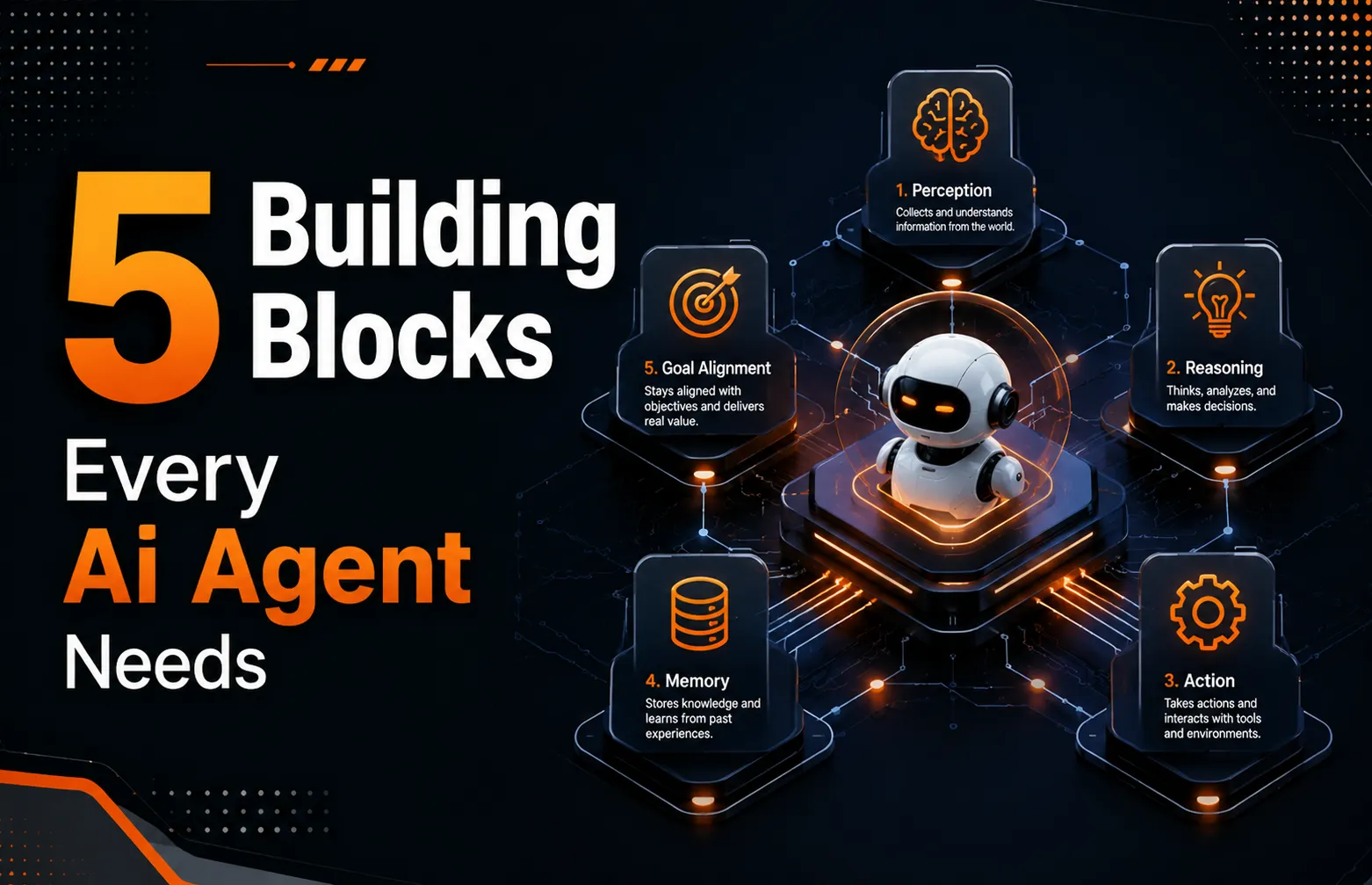
The 5 Building Blocks Every AI Agent Needs

By Vinay
Founder of Vtricks Technologies
Domain: Agentic AI Fundamentals | July 2026
Imagine you hire a new employee. On day one, would you expect them to read your mind, finish every task perfectly with zero instructions, and never ask a follow-up question?
Of course not. You'd give them access to files (memory), a laptop and software (tools), a project plan (planning), the ability to actually do the work (action), and regular check-ins to course-correct (feedback loops).
Here's the twist: that's exactly what an AI "agent" needs too.
Most people still think of AI like a vending machine, you type a query, a snack falls out. But agents like Claude, AutoGPT, and Devin are built to work more like employees. They don't just answer once and disappear. They remember, they use tools, they plan multi-step work, they take action, and they learn from what happens next. Let's break down the five building blocks that turn a plain chatbot into a genuine AI agent.
Memory: The Employee Who Doesn't Forget Everything by Lunch
Picture an employee with amnesia. Every morning, they forget your name, your project, and everything you told them yesterday. Frustrating, right? That's what early chatbots were like, every conversation started from zero.
Modern AI agents fix this with memory, the ability to hold onto information across a conversation, or even across days and weeks. There are usually two flavors:
- Short-term memory: what's happened in this conversation so far.
- Long-term memory: facts that persist across sessions, like preferences, past projects, or ongoing goals.
Claude, for example, can recall earlier parts of a long conversation and even reference past chats when memory features are enabled. This is the difference between talking to a stranger every time and talking to someone who actually knows you.
Why it matters: Without memory, an agent can't build on progress. It's stuck repeating the same first day, forever.
Tools: Giving the Employee More Than Just a Brain
A brilliant employee with no laptop, no internet, and no phone can only do so much. They can think, but they can't check today's stock price, send an email, or look something up.
This is why agents need tools, the ability to reach outside their own "brain" and interact with the real world. Tools might include:
Think of AutoGPT, one of the earliest popular autonomous agents. Its whole appeal was that it could search the web, write files, and chain tool calls together on its own, instead of just generating text and stopping. Claude works similarly, it can search the web for current events, run code to solve a math problem, or generate a document, rather than guessing from memory alone.
Why it matters: Tools turn an agent from a "smart talker" into someone who can actually check, build, and do.
Planning: Thinking Before Doing
Would you trust an employee who starts building a house before drawing up blueprints? Probably not.
Planning is the step where an agent breaks a big, messy goal into smaller, manageable steps, before rushing to act. This is what separates a simple chatbot from a true agent. For example, if you ask an agent to "build me a simple website," a good agent doesn't just start typing code randomly. It might silently reason:
- Figure out what pages are needed
- Decide on the structure and design
- Write the code section by section
- Test that it works
- Fix any errors
This is exactly what makes tools like Devin, often called an "AI software engineer", stand out. Devin doesn't just spit out one code snippet; it plans a sequence of tasks (write code, run tests, debug, repeat) the way a real developer would tackle a ticket.
Why it matters: Planning prevents chaos. It's the difference between an employee who dives in blindly and one who thinks two steps ahead.
Action: Actually Doing the Work
Here's the honest truth: plans are worthless if nobody executes them.
Action is where the agent moves from "here's what I'd do" to "here's what I just did." This might mean writing and running actual code, sending a real message, filling out a form, or making a purchase (with permission, of course).
This is the part that makes agents feel less like assistants and more like coworkers. Devin, for instance, can open a code editor, write files, run them, and fix bugs, all without a human typing every single line.
Of course, action comes with responsibility. A good agent knows which actions are safe to do automatically (like searching the web) and which need a human's green light first (like sending an email or spending money). It's the same trust you'd build with a new hire, you don't hand them the company credit card on day one.
Why it matters: Without action, an agent is just a very good advice-giver. Action is what makes things happen.
Feedback Loops: Learning From What Just Happened
Even the best employees don't get everything right the first time. What makes them great is how they respond after something goes wrong.
Feedback loops let an agent check its own work, notice mistakes, and adjust, instead of blindly moving forward. This might look like:
- Running code, seeing it fail, and debugging it
- Re-reading a draft and catching an error before sending it
- Asking a clarifying question when instructions are unclear
- Using a user's correction to improve the next attempt
This loop, plan, act, observe, adjust, is what allows agents to handle multi-step, real-world tasks instead of one-shot answers. Devin, for example, doesn't just write code once; it runs the tests, reads the error messages, and revises its own work, much like a developer debugging late at night.
Why it matters: Feedback loops are what let an agent recover from mistakes instead of confidently repeating them.
Putting It All Together: Hire, Don't Query
So next time you use an AI agent, try shifting your mental model. Don't think of it as a search engine you're querying. Think of it as an employee you're onboarding.
Products like Claude, AutoGPT, and Devin aren't magic, they're carefully engineered combinations of these five building blocks, each one compensating for what a plain language model can't do alone.
The next generation of AI won't be judged by how clever a single answer sounds. It'll be judged by how well it works, over hours, over days, across real tasks, just like any employee you'd actually want to keep around.