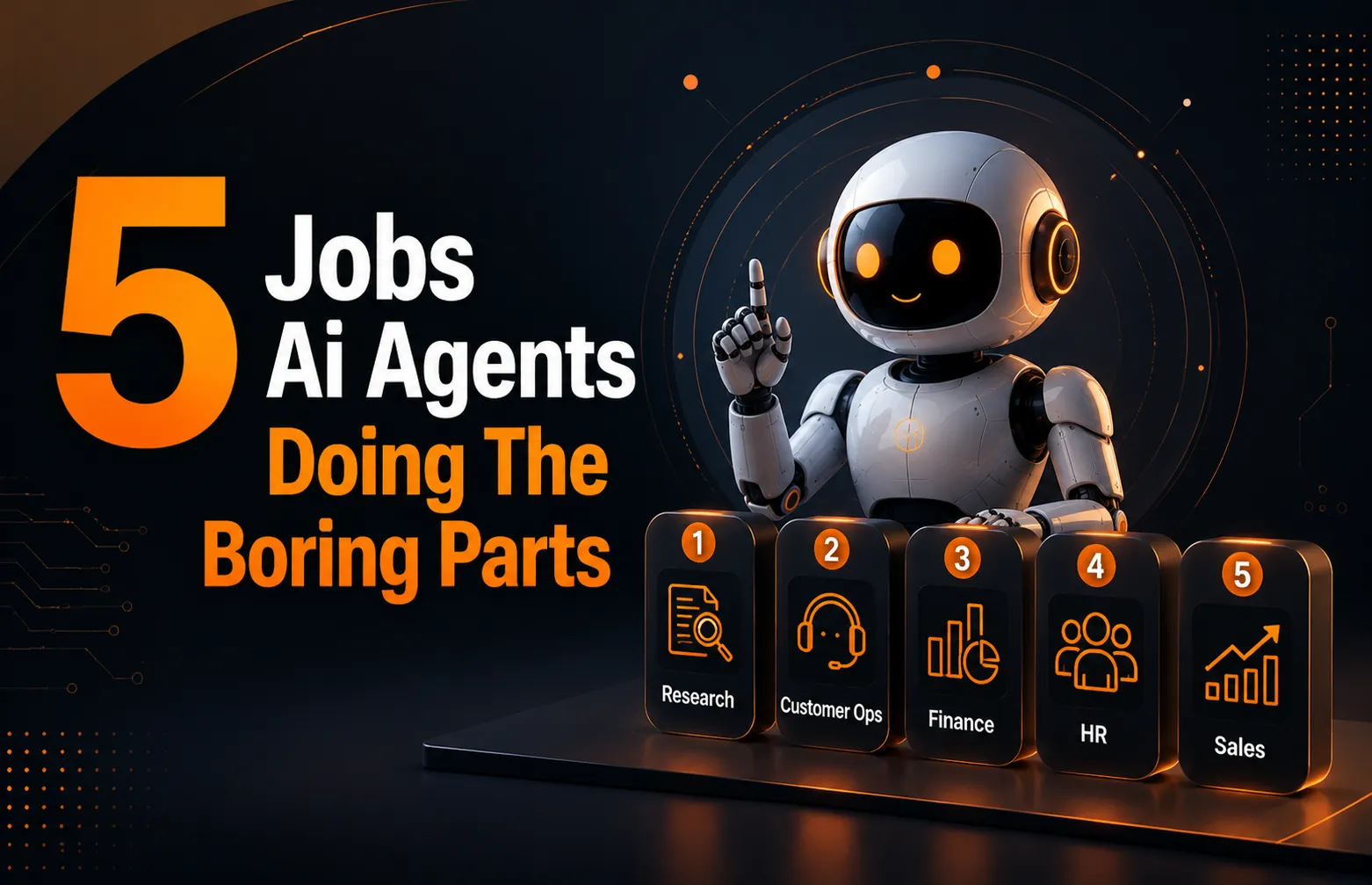
5 Jobs Where AI Agents Are Already Doing the Boring Parts

By Vinay
Founder of Vtricks Technologies
Domain: Agentic AI in the Workplace | July 2026
Nobody got into research to spend six hours copy-pasting data into spreadsheets. Nobody joined customer support dreaming of typing the same refund policy for the 400th time. Yet that's what a huge chunk of "knowledge work" actually looks like day to day.
Here's the quiet shift happening right now: AI agents aren't replacing these jobs. They're eating the boring middle of them, the repetitive, rule-based, copy-paste stuff, and leaving humans with the parts that actually need a human brain.
Let's walk through five real domains where this is already happening. No sci-fi. Just today.
Research: The Agent That Reads So You Don't Have To
Picture a market analyst who needs to understand the competitive landscape for electric vehicle batteries. The old way: open 40 browser tabs, skim each article, manually build a comparison table, and hope you didn't miss the one report that mattered.
Now, an AI agent does the first pass. You give it a prompt, "compare battery chemistry approaches from the top 6 EV makers, cite sources", and it goes out, reads dozens of documents, pulls the relevant numbers, and hands back a structured summary with citations attached. It doesn't decide what the findings mean for your company's strategy. That's still your job. But it just saved you a full day of tab-hopping.
Concrete Workflow
Analyst defines the question agent searches and reads agent drafts a structured brief with sources analyst reviews, challenges weak claims, and writes the actual recommendation.
The boring part (finding and organizing information) goes to the agent. The interesting part (judgment) stays with the human.
Customer Ops: The Agent That Handles the First 80%
Customer support has always had two kinds of tickets: the ones anyone could answer ("how do I reset my password," "where's my order") and the ones that need a real person untangling a messy, emotional, or unusual situation.
AI agents are now sitting in front of that first bucket. A support agent gets a message, checks the order status via an internal tool, checks the return policy, and either resolves it instantly or drafts a reply for a human to approve. Some setups let it fully close out simple tickets, refund under a certain amount, standard policy, no escalation flags, without a human touching it at all.
Concrete Workflow
Customer messages in agent pulls account and order data agent matches the issue against policy agent either resolves directly or flags it with a suggested response for a human agent to send.
What doesn't get automated: the customer who's furious, confused, or dealing with something outside policy. That's still where a human voice matters most, and now that's most of what the human support team spends their day on, instead of being buried in routine tickets.
Finance: The Agent That Closes the Books' First Draft
Anyone who's worked in finance knows "month-end close" is basically a horror story told in spreadsheets. Reconciling transactions, chasing down mismatched entries, flagging anomalies, formatting the same report for the fifth month in a row.
Finance teams are now running agents that pull transaction data from accounting systems, flag discrepancies automatically (a $50,000 invoice that doesn't match a matching PO, say), and generate a first-draft reconciliation report. The finance analyst's job shifts from hunting for the needle in the haystack to reviewing the needle the agent already found.
Concrete Workflow
Agent pulls ledger and bank data agent flags mismatches and unusual variances agent drafts explanatory notes analyst verifies, investigates true anomalies, and signs off.
Nobody wants an AI making the final call on a company's books. But letting it do the tedious matching and flagging first? That's hours back every single week.
HR: The Agent That Screens Resumes Like a Tireless Intern
Recruiters read a lot of resumes. Like, a genuinely absurd number, for roles that get hundreds of applicants. Most of that reading is just filtering, does this person meet the basic requirements, yes or no.
AI agents now do that first filter: parsing resumes against a job description, ranking candidates by fit, and even drafting personalized outreach messages for the top matches. The recruiter still does the actual interviewing, the gut-check conversations, the "does this person fit our team" judgment call that no algorithm should be trusted with.
Concrete Workflow
Applications come in agent parses and scores against job criteria agent surfaces top 10% with a short rationale recruiter reviews the shortlist and takes it from there.
This doesn't remove recruiters from hiring. It removes them from the pile of 300 resumes for a job with 8 real contenders.
Sales: The Agent That Does the Homework Before the Call
Good salespeople know that the difference between a cold pitch and a great pitch is research, knowing the prospect's company, their recent news, their likely pain points, before you ever pick up the phone.
Sales teams are now using agents to build that research automatically. Before every call, the agent pulls the prospect's company info, recent funding or news, tech stack signals, and drafts a personalized talking-points brief. It might even draft the follow-up email after the call, based on notes.
Concrete Workflow
Meeting gets scheduled agent researches the account and drafts a brief salesperson reviews before the call agent drafts follow-up email salesperson edits and sends.
The relationship-building, the read-the-room adjustments, the actual persuasion, still entirely human. The prep work that used to eat into selling time? Increasingly automated.
The Pattern Underneath All Five
Look closely and every example follows the same shape: agents handle the gathering, sorting, and drafting. Humans handle the judgment, the exceptions, and the final call.
That's not a small shift, but it's also not the job-eating apocalypse some headlines suggest. It's more like every knowledge worker suddenly got a very fast, very literal-minded assistant who never gets bored doing the parts nobody liked anyway.
The real question worth asking isn't "will AI take my job." It's: what would you do with your day if the boring 40% just disappeared? For a lot of people, across a lot of industries, that's not a hypothetical anymore. It's just Tuesday.