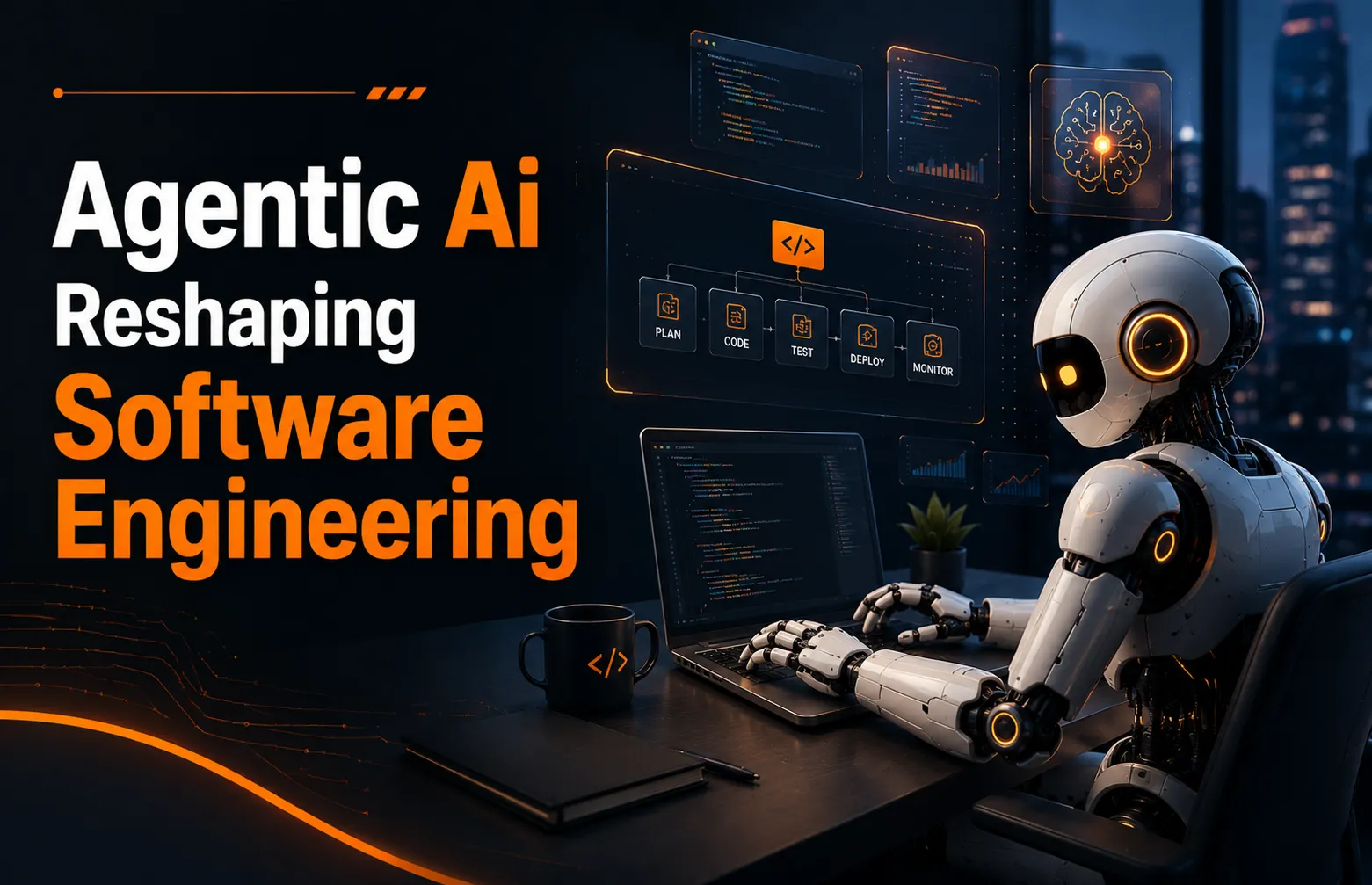
How Agentic AI Is Quietly Reshaping Software Engineering

By Vinay
Founder of Vtricks Technologies
Domain: Agentic AI & Software Engineering | July 2026
A year ago, "AI in coding" meant autocomplete. You typed a few characters, a ghost-grey suggestion popped up, and you hit Tab or you didn't. Useful, but boring. Nobody's workflow fundamentally changed.
Something different is happening now. Tools like Devin, Claude Code, and Copilot Workspace aren't just finishing your sentences, they're picking up tickets, writing code across multiple files, running tests, and opening pull requests. That's a different category of tool. It's not "smart autocomplete." It's an agent: something that takes a goal, makes a plan, and works through it with minimal hand-holding.
But here's the thing every practitioner already suspects: the marketing is ahead of the reality. So let's cut through it. What do these tools actually do today, and where do they still fall apart?
What "Agentic" Actually Means
An agentic coding tool has three ingredients a plain autocomplete tool doesn't:
A Loop, Not a Single Response
It writes code, runs it, reads the error, and tries again, without you copy-pasting stack traces back and forth.
Tool Use
It can open a terminal, run tests, browse a codebase, check documentation, or hit an API.
Multi-Step Planning
Given "add rate limiting to the login endpoint," it breaks that into: find the endpoint, check existing middleware patterns, write the limiter, wire it in, write a test, run the test suite.
That loop is the whole story. It's why these tools feel less like a smarter editor and more like a very junior engineer who never gets tired of running npm test for the tenth time.
What They're Actually Good At Right Now
Bounded, Well-Specified Tasks
Give Claude Code a task like "migrate this component from class syntax to hooks" or "add input validation to these five API routes," and it will genuinely do the tedious work: read each file, apply the pattern consistently, run the linter, fix what breaks. This is the highest-value use case today, mechanical, repetitive, well-defined refactors that used to eat an afternoon.
Bug Reproduction and Fixing in Isolated Contexts
Devin's demo videos oversold "autonomous engineer," but the underlying capability, take a bug report, reproduce it in a sandbox, bisect to the cause, patch it, verify with a test, works reasonably well when the bug is reproducible and the codebase isn't sprawling with hidden cross-service dependencies.
First-Draft PRs for Well-Scoped Features
Copilot Workspace shines at turning an issue into a working plan and initial diff: "add a dark mode toggle to settings" becomes a real branch with real changes. It's a first draft, not a merge-ready PR, but a first draft that would've taken you 45 minutes now takes 5.
Test Writing and Coverage Gaps
Agents are excellent at looking at existing code and generating a reasonable test suite for it, including edge cases you'd probably think of eventually but not immediately.
Where the Hype Outruns the Reality
Large, Ambiguous, Multi-Service Tasks
"Build the whole notifications system" sounds like exactly what an autonomous agent should do. In practice, this is where agents drift, making architectural decisions nobody agreed to, missing an existing utility three folders over, or quietly reinventing something that already exists in the codebase. The bigger the task, the more the agent's plan diverges from what a senior engineer would actually choose.
Understanding Why, Not Just What
Agents are pattern-matchers with tool access. They don't know that the team decided six months ago never to touch the payments service without a migration plan, or that a particular "hacky" piece of code is load-bearing for a client contract. That institutional memory doesn't live in the repo, so it doesn't live in the agent.
Debugging Genuinely Novel Problems
Agents are strong at bugs that resemble known patterns. A race condition that only shows up under specific production load, or a subtle state-management bug three abstraction layers deep, still usually needs a human who can hold the whole system in their head.
Trust Without Verification
The riskiest failure mode isn't the agent writing bad code, it's the agent writing plausible-looking code that passes a shallow test but breaks an assumption elsewhere. Confidence and correctness are not the same thing, and these tools are very confident.
What Your Workflow Actually Looks Like Now
For practitioners already using these tools daily, the emerging pattern looks like this:
You still write the ticket. A clear, scoped task description is the single biggest lever on output quality. Vague prompts get vague, sprawling diffs.
You review like it's a junior's PR, not your own code. Line by line, with extra suspicion around edge cases and error handling.
You reserve agents for the tasks you'd delegate to an intern with strong technical skills but zero context, refactors, boilerplate, test scaffolding, migrations, first-draft features.
You keep architecture, cross-service decisions, and anything touching money, auth, or data integrity firmly in human hands, at least for now.
You treat the agent's test run as a smoke test, not a guarantee. Green CI from an agent-written PR deserves the same skepticism as green CI from a rushed human one.
So What's Actually Changing?
Not "engineers are being replaced." What's actually shifting is the shape of a senior engineer's day. Less time typing boilerplate, more time reviewing, specifying, and making the judgment calls that agents can't. The job is quietly moving from writer of code to reviewer and director of code, which, if you've been doing this a while, is a role you already partly occupy when mentoring juniors.
The teams getting real value aren't the ones chasing full autonomy. They're the ones who've figured out exactly which 30% of their work is mechanical enough to hand off, and who never stop reading the diff.