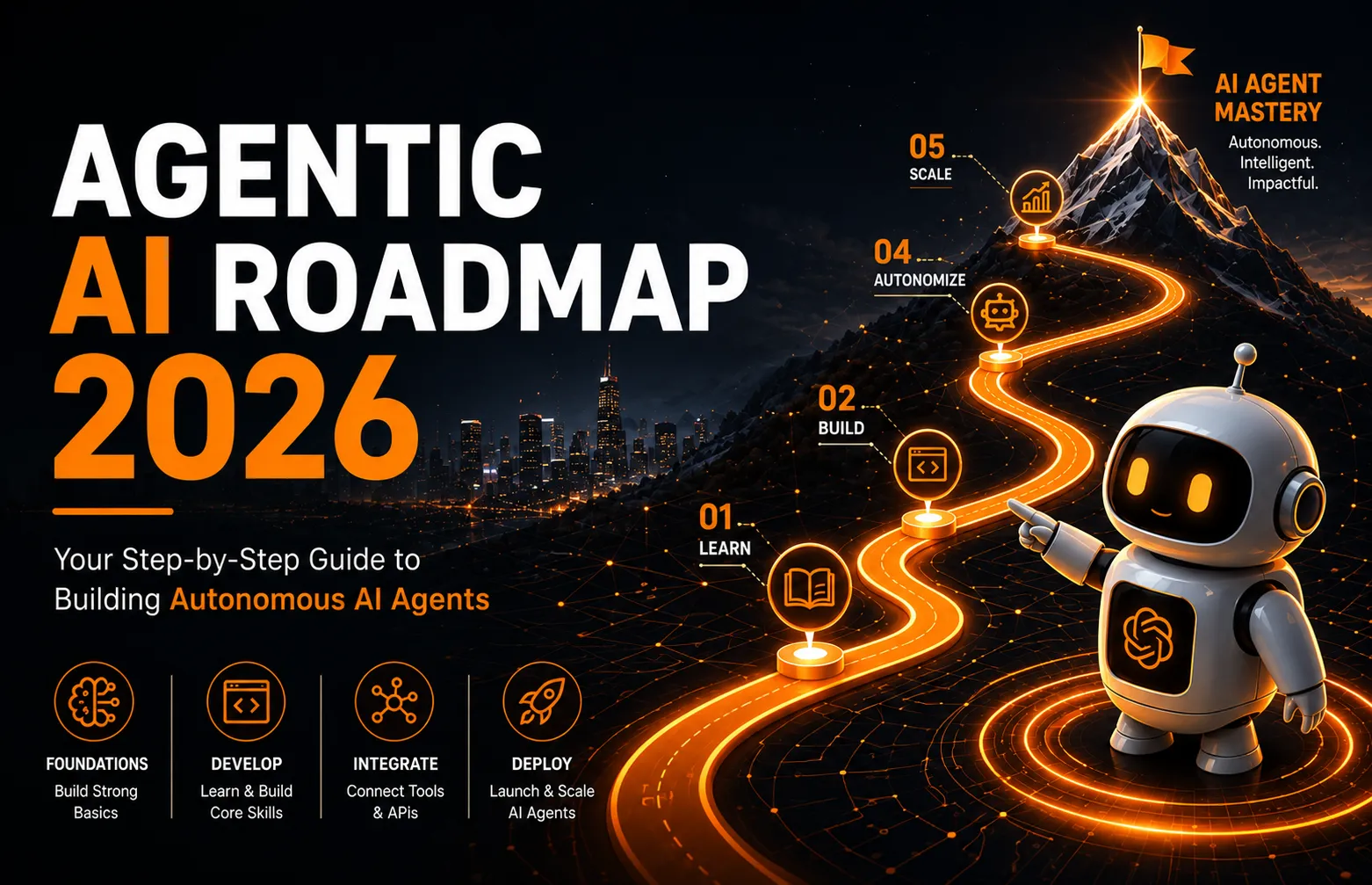
Agentic AI Roadmap 2026: Complete Learning Path

By Vinay
Founder of Vtricks Technologies
Domain: Agentic AI & Emerging Tech Careers | July 2026
Artificial Intelligence is evolving rapidly, and Agentic AI is leading the next wave of innovation. Unlike traditional AI systems that simply respond to prompts, Agentic AI systems can plan, reason, make decisions, use tools, interact with multiple applications, and complete tasks with minimal human intervention.
If you're planning to build a career in AI in 2026, understanding the complete Agentic AI roadmap is essential. Whether you're a student, software engineer, data analyst, automation professional, or working IT employee, learning Agentic AI can open doors to some of the fastest-growing technology careers. In this guide, we'll explore the complete learning path, required skills, tools, projects, and certifications to become an Agentic AI Engineer.
What is Agentic AI?
Agentic AI refers to intelligent AI systems capable of understanding goals, planning multiple steps, making decisions, using external tools, accessing APIs, collaborating with other AI agents, learning from feedback, and completing end-to-end workflows. Instead of answering one prompt at a time, Agentic AI behaves more like a digital employee capable of performing complex business operations.
Examples include: AI customer support assistants, autonomous coding assistants, AI research agents, AI business analysts, AI HR assistants, AI financial advisors, and multi-agent enterprise automation systems.
This is why organizations worldwide are investing heavily in Agentic AI solutions.
Why Learn Agentic AI in 2026?
The AI industry is shifting from Generative AI to autonomous AI systems. Companies are now hiring professionals who can build AI Agents, Multi-Agent Systems, AI Automation, AI Workflows, AI Copilots, and Enterprise AI Solutions. Learning Agentic AI gives you an advantage over professionals who only know prompt engineering or chatbot development.
Complete Agentic AI Learning Roadmap
Learn Python Programming
Python is the foundation of AI development. Learn variables, functions, loops, classes, OOP, exception handling, file operations, APIs, and virtual environments.
Recommended libraries: NumPy, Pandas, Requests, FastAPI, Flask. Without Python, building AI agents becomes difficult.
Understand AI & Machine Learning Basics
Before building AI Agents, understand Artificial Intelligence, Machine Learning, Deep Learning, Neural Networks, NLP, and Transformers, this helps you understand how Large Language Models work.
Learn Prompt Engineering
Prompt Engineering is still an important skill: zero-shot prompting, few-shot prompting, chain of thought, role prompting, structured prompting, prompt optimization, output formatting, and prompt chaining.
Good prompts produce better AI agents.
Master Large Language Models (LLMs)
LLMs are the brain behind Agentic AI. Key concepts: tokenization, context window, embeddings, vector search, fine-tuning, function calling, tool calling, and reasoning models.
Popular LLMs: GPT Models, Claude, Gemini, Llama, Mistral. Understanding how LLMs reason is essential for building reliable agents.
Learn Retrieval-Augmented Generation (RAG)
RAG allows AI systems to retrieve real-time information before generating responses. Key topics: embeddings, chunking, vector databases, semantic search, knowledge base integration, document retrieval.
Popular vector databases: Pinecone, ChromaDB, FAISS, Weaviate. RAG enables intelligent assistants built on private company data.
Learn LangChain
LangChain helps developers create advanced AI workflows using chains, memory, tools, agents, output parsers, document loaders, retrievers, and custom chains, simplifying AI application development significantly.
Learn LangGraph
LangGraph is becoming one of the most valuable frameworks for building Agentic AI applications: stateful agents, multi-step workflows, multi-agent collaboration, human-in-the-loop systems, and decision trees. Many enterprise AI applications now use it for orchestration.
Learn Model Context Protocol (MCP)
One of the biggest skills for 2026. MCP enables AI agents to securely communicate with databases, CRMs, file systems, business applications, APIs, and internal tools.
Learning MCP allows developers to build enterprise-ready AI agents that integrate with existing business systems.
Build AI Agents
Now comes the exciting part, create agents for email automation, resume screening, customer support, market research, travel planning, sales automation, healthcare assistance, and HR automation. Each project strengthens your portfolio.
Learn Multi-Agent Systems
Modern enterprises rarely rely on a single AI agent. Instead, multiple specialized agents, research, planning, coding, testing, and reporting agents, work together, improving efficiency and scalability.
Deploy AI Applications
Deployment is a critical skill: FastAPI, Docker, GitHub, Git, cloud deployment, API hosting, authentication, and CI/CD.
Knowing how to deploy AI applications makes you industry-ready.
Essential Tools to Learn
Your Agentic AI toolkit should include the following, commonly used across enterprise AI development:
Projects You Should Build
Practical projects demonstrate your skills to employers. Showcasing these on GitHub and LinkedIn can significantly improve your visibility:
- AI Resume Analyzer
- AI Interview Assistant
- AI Customer Support Agent
- AI Financial Advisor
- AI Research Assistant
- AI Code Reviewer
- AI Travel Planner
- AI Document Analyzer
- AI Healthcare Assistant
- Multi-Agent Business Automation System
Career Opportunities After Learning Agentic AI
Professionals with Agentic AI expertise can pursue roles such as Agentic AI Engineer, AI Engineer, LLM Engineer, Prompt Engineer, AI Automation Engineer, Machine Learning Engineer, AI Product Developer, AI Solutions Architect, Generative AI Developer, and AI Consultant.
Industries actively adopting Agentic AI include healthcare, finance, retail, manufacturing, education, logistics, and SaaS.