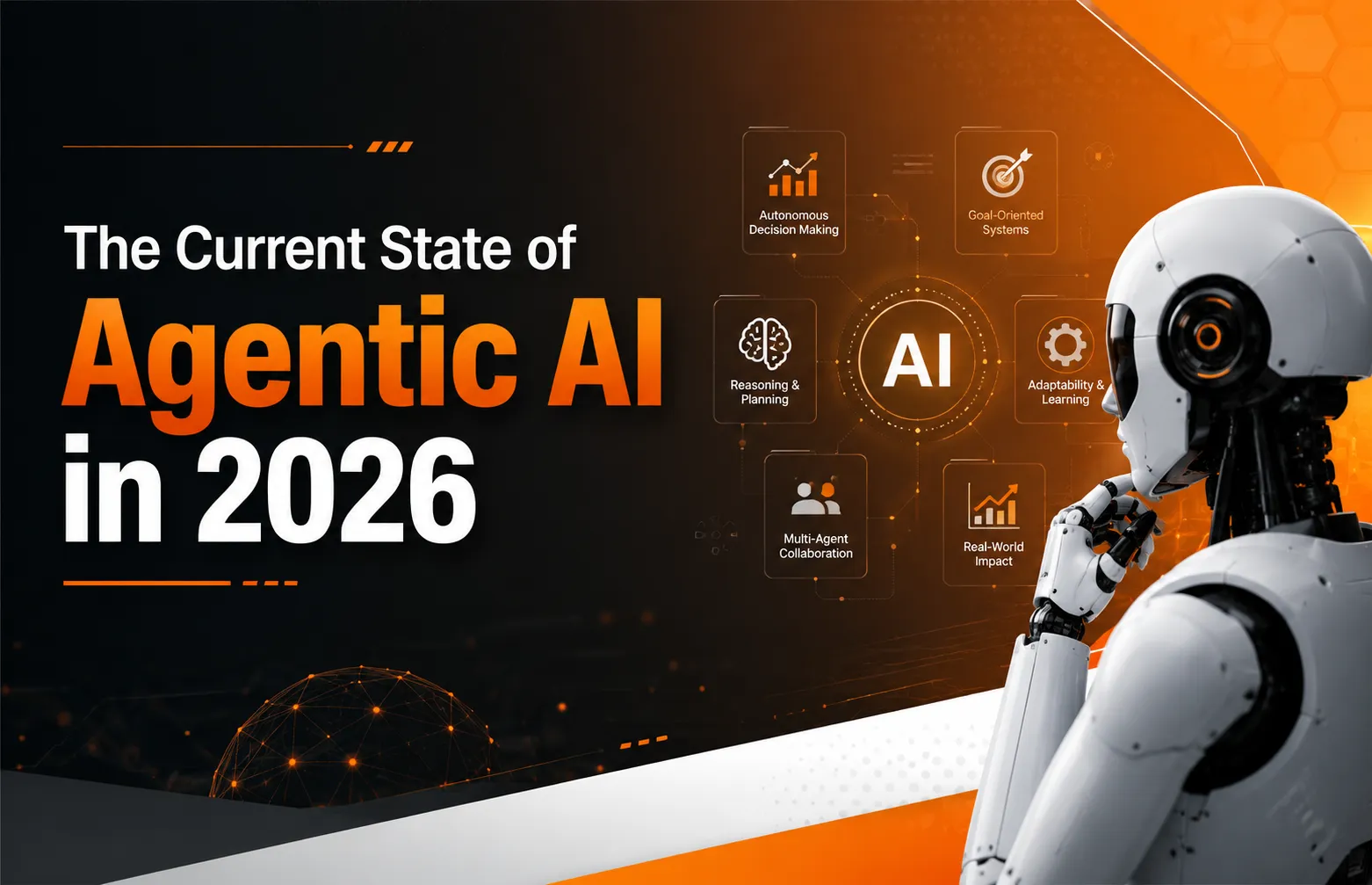
The Current State of Agentic AI in 2026

By Vinay
Founder of Vtricks Technologies
Domain: AI Industry Trends & Careers | July 2026
Artificial Intelligence has undergone a massive transformation over the last few years. What started as rule-based automation evolved into Machine Learning, then Generative AI, and today we have entered the era of Agentic AI.
Unlike earlier AI systems that simply responded to user inputs, today's AI can reason, plan, make decisions, collaborate with other AI agents, use business tools, and complete complex tasks autonomously. This shift is redefining industries and creating a huge demand for professionals with Agentic AI skills.
In this article, we'll explore the current state of Agentic AI, compare it with previous generations of AI, understand where the technology is heading, and explain why learning Agentic AI has become one of the most valuable career investments in 2026.
The Evolution of AI: From Reactive Systems to Intelligent Agents
Understanding today's Agentic AI becomes easier when we look at how AI has evolved.
Traditional AI (Before 2022)
Traditional AI systems were designed to perform specific predefined tasks: rule-based automation, limited learning capability, fixed workflows, no contextual understanding, no reasoning ability, and dependence on human instructions.
Examples: basic chatbots, recommendation engines, spam filters, OCR software, and voice assistants with predefined commands. Useful, but inflexible beyond what they were programmed to do.
Generative AI
The launch of Large Language Models revolutionized AI. Instead of only following rules, AI could generate text, write code, create images, summarize documents, translate languages, and answer complex questions.
Popular models: GPT, Claude, Gemini, Llama, and Mistral. It boosted productivity, but had one key limitation, it waited for humans to tell it what to do.
The Current Era - Agentic AI
Today's AI doesn't just respond, it acts. Modern Agentic AI systems understand goals, break complex problems into smaller tasks, plan workflows, use APIs and software tools, access databases, search internal documents, collaborate with multiple AI agents, make informed decisions, ask follow-up questions when needed, and complete end-to-end business processes.
Instead of acting like a chatbot, Agentic AI behaves like a skilled digital teammate.
Traditional AI vs Current Agentic AI
| Traditional AI | Current Agentic AI |
|---|---|
| Follows predefined rules | Plans and executes tasks autonomously |
| Single prompt-response interaction | Multi-step reasoning and execution |
| Limited memory | Maintains context across workflows |
| Cannot use external tools effectively | Integrates with APIs, CRMs, databases, and enterprise systems |
| Requires continuous user guidance | Works toward goals with minimal supervision |
| Mostly reactive | Proactive and goal-oriented |
| Performs isolated tasks | Coordinates complete business workflows |
This evolution is why organizations are shifting from chatbot implementations to enterprise AI agents.
What Makes Today's Agentic AI Different?
The biggest difference is autonomy. Current AI systems are no longer limited to generating responses, they can independently coordinate multiple actions.
For example, an AI sales assistant today can read incoming leads, qualify prospects, search CRM records, draft personalized emails, schedule meetings, update customer information, and notify the sales team, all with minimal human intervention.
This is the defining characteristic of Agentic AI.
Technologies Powering Modern Agentic AI
Today's intelligent agents rely on a combination of advanced technologies.
Large Language Models (LLMs)
LLMs provide reasoning, language understanding, and decision-making capabilities.
Retrieval-Augmented Generation (RAG)
Allows AI to retrieve accurate information from company documents before responding.
LangChain
Helps developers connect prompts, tools, memory, and workflows into intelligent applications.
LangGraph
Enables multi-step, stateful, and collaborative AI workflows that can manage complex tasks.
Model Context Protocol (MCP)
MCP has become a key technology in 2026 because it standardizes how AI agents securely connect with business applications, databases, CRMs, file systems, productivity tools, and enterprise APIs.
Multi-Agent Systems
Instead of relying on a single AI model, organizations now deploy specialized AI agents that collaborate to solve problems efficiently.
Where Is Agentic AI Being Used Today?
Agentic AI is already transforming multiple industries.
Healthcare
Clinical documentation, patient support, appointment scheduling, and medical research assistance.
Finance
Fraud detection, investment research, financial reporting, and risk analysis.
Human Resources
Resume screening, candidate matching, employee onboarding, and internal support assistants.
Customer Service
AI support agents, ticket routing, automated issue resolution, and personalized customer interactions.
Software Development
Code generation, testing, documentation, bug detection, and DevOps automation.
Marketing
Campaign planning, SEO content generation, competitor analysis, audience research, and marketing automation.
These applications demonstrate why Agentic AI has become a strategic priority for businesses worldwide.
Why Businesses Are Investing in Agentic AI
Organizations are adopting Agentic AI because it delivers measurable business value:
Instead of replacing employees, Agentic AI increasingly works alongside them, handling repetitive and time-consuming tasks while people focus on strategy, creativity, and relationship-building.
Skills You Need to Build Agentic AI Solutions
As the technology evolves, employers are looking for professionals who understand more than just prompting AI:
Developing these skills positions you for a wide range of AI-focused careers.
Career Opportunities in the Agentic AI Era
With businesses accelerating AI adoption, demand for skilled professionals continues to rise. Popular job roles include Agentic AI Engineer, AI Engineer, LLM Engineer, Prompt Engineer, AI Automation Engineer, Generative AI Developer, AI Solutions Architect, AI Product Engineer, AI Consultant, and Enterprise AI Developer.
Professionals with practical experience in building AI agents and enterprise workflows are especially sought after.
The Future of Agentic AI
The future of AI is no longer about generating content, it is about creating intelligent systems that can think through problems, collaborate with tools, and complete meaningful work.
As Agentic AI becomes deeply integrated into business operations, professionals who understand autonomous AI, LLMs, MCP, LangGraph, and multi-agent systems will have a significant advantage in the job market. Now is the right time to invest in these skills and prepare for the next generation of AI-driven innovation.